PINPOINT BLOG
You may need to log in to view member-only content. 🔐
This blog is for educational and informational purposes only. It is not medical, legal, or professional advice.
For any specific questions or concerns, please consult the appropriate qualified provider.
Not a member yet? Join free to unlock exclusive member-only content here.
Affiliate Disclosure: Some links on this site are affiliate links, including through Amazon’s Associates program. This means Pinpoint Education may earn a small commission at no extra cost to you—if you choose to make a qualifying purchase. All products and services featured are personally vetted; payment is not accepted for mentions or reviews. Your support helps sustain this platform and allows Pinpoint to continue offering free, high-quality content. Thank you.
PINPOINT B L O G
You may need to log in to view member-only content. 🔐
Not a member yet?
Join free to unlock exclusive member-only content here.
Disclaimers & Disclosures:
About:
This blog is for educational and informational purposes only. It is not intended as medical, legal, or professional advice. For any health-related concerns, please consult a qualified medical provider.
Affiliate Disclosure:
Some links on this site are affiliate links, including through Amazon’s Associates program. This means Pinpoint may earn a small commission—at no extra cost to you—if you make a qualifying purchase. Only resources aligned with Pinpoint's standards are ever shared. Your support helps keep educational content accessible and ad-free. Thank you.
The Aescape Massage Robot Collapsed. $157 Million Later, Here's Why.
 Tania Velásquez
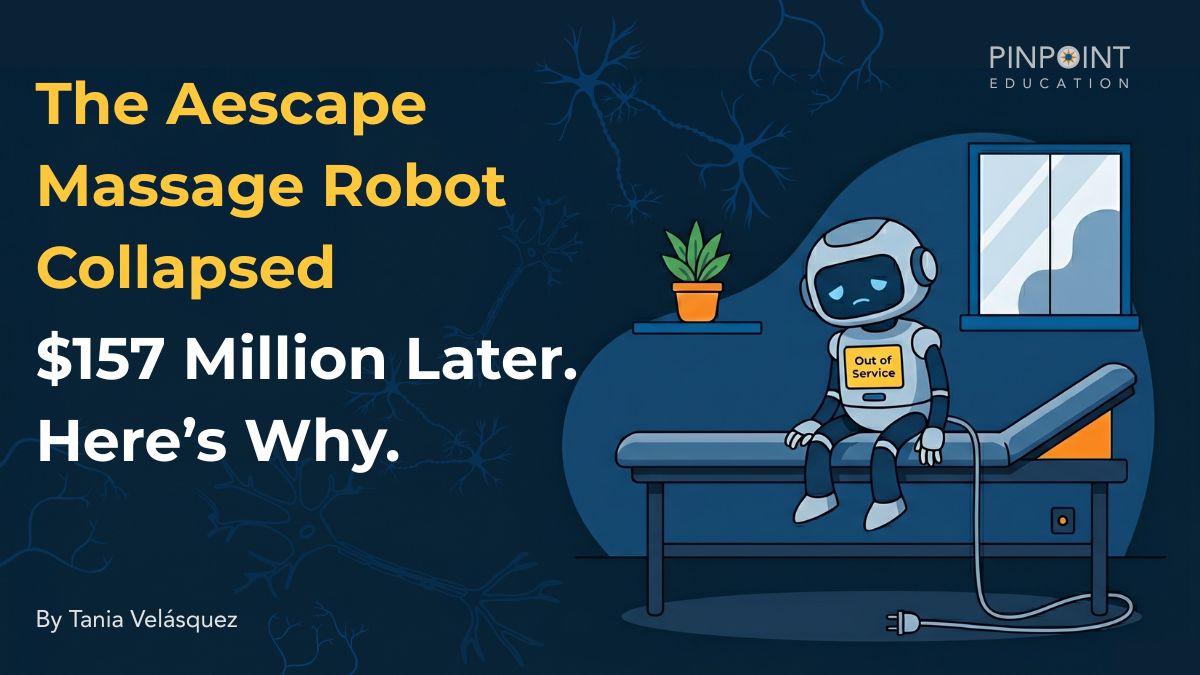
Aescape massage robot bankruptcy raises questions about automation, therapist jobs, and the future of the massage therapy profession.
Published May 9, 2026 | Reading Time 📖 10 min • 2519 words
Intro
The collapse of Aescape Inc. is a vindication of everything science has been confirming about the importance of human touch and a wake-up call about who really represents what therapeutic massage is about.
In April 2026, Aescape Inc., the AI-powered robotic massage company that spent nearly a decade promising to "revolutionize" the wellness industry ran out of battery (revolutionize is apparently the new corporate codeword for "replacing humans").
The company had raised over $130 million, counted NFL legend Tom Brady as a partner, and landed the rubdown machines prime placement in Equinox, Four Seasons, Life Time and Marriott. The future of massage had arrived.
But then the company that promised the future became insolvent. Unable to pay its debts, it’s been forced to sell off its remains and the investors who poured $152.6 million into this sci-fi fever dream of automated bodywork have been kindly informed they'll probs never see that money again.
If only this could have been prevented somehow.
The Science of Touch Physiology Tried to Warn Them
Aescape spent years developing AI-assisted robotic massage tables before finally reaching public operations in 2024. Their pitch was compelling on paper: consistent treatment delivery, data capture, scalable wellness technology called "massage."
No need to pay as many pesky human employees anymore.
Here's the irony. 'Consistent treatment delivery' sounds reassuring. But in therapeutic massage, true consistency means consistently responding to what the body needs second-by-second, not delivering the same pre-programmed sequence regardless.
Tissue quality changes. Tension shifts. What a client needs on Monday after a stressful weekend is categorically different from what they needed the Friday before.
Who could have ever imagined that the ability to anticipate needs, respond, and adapt in real time through warm-blooded hands with the capacity to calm other humans is something a giant robot couldn't do as well.
We massage therapists are all equally shocked to have learned this.
The difference between a robot and a human
A robot is a cute novel gadget but it does not have a nervous system that can assess the tissue of another nervous system. It cannot detect the millisecond involuntary flinch that tells you to back off.
It cannot discern why someone is holding their breath. It cannot make the clinical decision to change course mid-session because something doesn't feel right, or inform someone they should get a suspicious looking mole checked out and potentially prevent a melanoma from spreading.
But to the robot's credit, it can definitely apply consistent pressure to a pre-mapped body. So can a foam roller. So can a gadget from an online store that can be returned within 30 days if you don't like it.
So can the massage chair at the airport that has existed for decades and costs a fraction of what Aescape was suggesting to charge warm bodies for the bucket-list experience.
Which brings us to the pricing.
Aescape positioned its robotic sessions at rates comparable to a human massage therapist. Sans humanity. No clinical reasoning. No license. No liability beyond whatever the hosting facility could be held to under a legal framework that, notably, nobody had fully figured out yet.
It was morphing into a full Three Stooges episode over a product there was no consumer demand for, because it already existed in the Sharper Image catalog. Now on Amazon for $49.99 with free returns.
“How I wish there was a giant robot I could always book instead of massage therapists”, said no one ever.
The Legislative Theater Nobody Needed
While Aescape was burning through its investor capital, the profession was being dragged into legislative debates about whether robotic massage required licensure, whether it constituted unauthorized practice, whether the robot service could even be called "massage therapy," and how liability would work if a machine caused injury.
Cue Maximum Overdrive level anxiety. (TW: Stephen King movie clip 🫣)
The massage profession, already navigating a patchwork of inconsistent state licensing requirements, was suddenly being asked to justify its existence against a glorified airport chair that scanned bodies with LiDAR technology and stored that data somewhere alongside a favorite Spotify relaxation playlist, or something like that.
The group chat was not okay.
State boards scrambled to define scope of practice for something that had no real demand outside of "ooo neato."
Massage therapists employed at certain premium fitness and spa chains or hotel wellness centers weren't exactly thrilled as they watched Rosy the Robot briefly steal the spotlight and threaten their livelihood. Some owners insinuated that automation was the new direction and human employees would be optional.
To be fair, novelty is attractive to our human nature. We all love to try a fun new amusement park ride. Just not all the time. Not for $60-$120 a pop. And certainly not while having to wear tight synthetic spandex provided for you… where you can only trust it's been properly laundered.
This industry spent real time and real energy stressing about a problem that the free market ultimately solved on its own. $157 million and a foreclosure auction later = problem solved.
Though if you're still curious, Aescape continues to operate at select locations and is also available for home purchase.
The machines themselves retailed for $105,000 plus a $10,000 annual fee, so the venues that bought in will be working towards recouping that investment for a while.
Maybe they'll offer complimentary rides to the massage therapists they fantasized about replacing? And maybe we'll put in a good word, especially if the devs are still offering $25 gift cards for feedback ;)
Advocates Behind the Scenes
Here's where the conversation gets uncomfortable and more interesting.
Aescape was not operating in a vacuum. It attracted investors, advisors, company owners, and "advocates" from within the wellness and massage therapy industry itself.
Et tu, Brute?
These included figures with visibility and credibility in the profession, including individuals directly connected to massage school boards and educational institutions, as well as large massage franchise networks that publicly position themselves as supporting the careers of massage students and working professionals.
Let that marinate for a minute.
People positioned as stewards of the massage profession, people who publicly sell the value of therapeutic touch and claim to support working therapists, had financial stakes in a company whose business model depended on automating massage services. I find that strange.
This is not a conspiracy theory. It's a conflict-of-interest concern the massage therapy profession has been slow to name out loud. Why is that?
Employees, students, and working professionals deserve transparency about whose interests are being advanced when industry voices advocate for technology that could threaten their livelihoods.
But this has been a great opportunity to see who really stands for what, and how their went about rolling out the Roomba of massage.
What Can We Learn from The Big Massage Robot?
Now it's time to be fair to the Aescape robot for a moment. And more importantly, be honest with ourselves as a profession.
Because some people actually liked it, and some even preferred it to the human massages they've experienced so far. It's a good idea for massage therapists to take in the positive reviews, too.
The robot deserves extra credit because it has done an important job at mirroring where we are and where things could go south if the profession doesn't step up its game asap.
Joking aside, there is absolutely a market for what the Aescape massage robot offers. And it can still scratch a certain itch for some people, in certain contexts. And this is where I'm #TeamRobot.
Some users described the Aescape experience as novel, efficient, and surprisingly enjoyable. "No conversational pressure" was a recurring positive comment. People loved not having to make small talk that felt forced.
People liked not having to navigate the social dynamics of being touched or feeling judged by another human being.
One reviewer said it "gets into spots humans are too afraid to touch." Another said "honestly, better than a human."
Read that last one again. Because there is something to learn here.
The market has shown us this isn't true across the board. But if even one client has felt that way about a massage experience, that's feedback worth meditating on.
The robot outperformed in areas where there are typically training gaps across entry-level and continuing education requirements for massage therapy.
No awkward check-ins that break the flow for relaxation.
No pressure to perform socially.
No wondering if or how they can give the therapist feedback that will actually be listened to and applied in real time.
No therapist who seems distracted or disengaged.
No being left dissatisfied by an experience where a therapist wasn’t trained on how to balance what a client expects with what is best practice for their presentation because they were uncertain, uninformed, or over-zealous.
This is not an indictment of the profession. It's simply long overdue feedback some may not have wanted to hear, but need to.
These gaps are not intentional nor are they any one therapist’s fault because this layer of critical skill is what’s been sorely lacking across most manual therapy training at all levels.
But the good news is non-verbal and verbal communication techniques can be learned and applied like any other as soon as our profession demands better of itself.
The real long-term threat was never that robots would eliminate massage therapists entirely. It's that automation lowers the overall standard of massage, reduces the perceived value of skilled bodywork, and changes what consumers learn to accept and are willing to pay for.
When a robot becomes someone's reference point for massage, they may never discover what skilled manual therapy can actually do to treat pain, rehabilitate mobility, and improve quality of life on various levels. And this is the real loss.
This has already played out in fitness coaching, photography, and tax prep, and the profession would do well to pay attention.
The therapists who thrive are the ones whose value cannot be reduced to a price comparison with a machine, because what they deliver cannot be replicated by anything running on a power cord.
No need to panic if you’re better than a robot
Massage therapists who didn’t stress about a robot takeover have clients who would never in a million years consider a $105,000 robot a viable substitute.
These professionals have developed the necessary “soft-skills” for understanding how to intuitively balance client expectations with clinical expertise.
They've learned to read the room, confident they cannot be replaced by any machine. They don't need to fill session-silence with chatter and welcome challenges as opportunities to get better and better at their craft.
They go where the nervous system of their client needs them most and pursue trainings that are up to speed with current healthcare standards and client care.
We welcome the robots because they only prove the point that there’s no substitute for human contact. They’re even kinda cute.
If there's anyone who's never considered this, the robot has prophesied now is a good time.
Supply and demand
It's also worth acknowledging that the massage robots have been filling a very real supply gap. There simply aren't enough licensed massage therapists to meet current growing demand (that’s another loaded topic for another day).
If someone needs stress-relief bodywork and a therapist isn't available, a mechanical option exists. That's very useful and I don’t mind that at all.
Just don't confuse a mechanical-itch-scratcher with a replacement for a human trained in pain relief. Prioritizing profit margins over people is generally not becoming of businesses claiming to care about human beings.
Back to the future of massage
There's a difference between providing a utility and providing massage therapy. To conflate them can result in a messy spectrum of harm.
On the worst end is a devaluing of basic humanity, and at the other end we find investors losing out on chunks of money that could have been better spent on something like… oh, perhaps building custom team training programs or tailored continuing education for employee development, at a tenth of the cost.
Maybe the future of massage involves companies investing in wellness approaches that meaningfully increase HUMAN customer satisfaction, improve retention, and actually boost team morale — proven to directly increase customer satisfaction — instead of tech fads that are generally demoralizing and dystopian? 🤔
Just a crazy idea. What do I know? Ask the market.
Onward and Forward
Of course there’s a sequel.
In his second act, the original Aescape founder has since launched a venture called Healthspanners. It’s described as a three-year $75,000 "health optimization" program available to 25 hand-selected members, mostly other founders and investors.
For that nominal fee, you get (well, not YOU, but they get):
a dedicated “Clinical Lead” who designs the “quarterly protocols”
quarterly analysis of 200+ biomarkers (which, for the uninitiated, is a very expensive way of saying “blood work for funsies”)
intimate group dinners with researchers, because THIS is what the market actually yearns for, also quarterly
These exclusive, buzzword-rich bio-optimization cohorts revolve around hyper-personalized clinical attention + highly curated human connection. The same things skilled massage therapists have been delivering for centuries (sometimes also on a quarterly basis), minus the $75K price tag and the themed supper club.
As it turns out, human touch and human interaction is quite valuable when you're the one receiving it and/or profiting from it. I’m a little jelly, sounds like a great time.
This Is Why Pinpoint Exists
Pinpoint Education was built on a simple premise: the profession deserves better. Better education. Better practice standards. Better business models. Better information, and better transparency about who is shaping this industry and what their motivations are.
The Aescape story is not just about a robot that flopped. Kudos for trying out something bold and new, Hundo P.
On a more substantive level it’s about what happens when outsiders who do not understand the tactile nuance of massage or the clinical complexity of manual therapy try to omit the human from the most primal of human interactions and commodify skill as incidental.
And it’s about what happens when the profession's own advocates prioritize investor returns over practitioner welfare and mutual respect, while trying to frame it as a favor to massage therapists. Huh?
With that, we sincerely thank the Aescape robot for revealing the truth about what some in this industry actually care about most, and it isn't advocating for the massage profession or their employees, at the very least.
Who’s actually ready to have that conversation?
The robots are here to stay, and that’s ok
There's a place in this world for robots. And anyone who is happy to pay the same price for a robot massage as they would for a real human therapist should absolutely have that option in the free market.
As massage therapists, it's now our baseline responsibility to be better than a robot. That's very doable.
In the meantime, Healthspanners states it’s self-funded to date, while Aescape has rebranded under new owners. Its OG investors are still owed $152.6 million. I was never very good at math.
We wish them all well. bleep-bloop 🤖
ABOUT THE AUTHOR
Tania is the founder of Pinpoint Education and teaches massage and manual therapy with a focus on what works. She specializes in precise neurocentric, evidence-informed approaches and maintains an active practice in New York City. Learn more at TaniaVelásquez.com.
Categories: : Industry, Massage Practice & Career, News
The Aescape Massage Robot Collapsed. $157 Million Later, Here's Why.
Aescape massage robot bankruptcy raises questions about automation, therapist jobs, and the future of the massage therapy profession.
Published May 9, 2026 | Reading Time 📖 10 min • 2519 words
Intro
The collapse of Aescape Inc. is a vindication of everything science has been confirming about the importance of human touch and a wake-up call about who really represents what therapeutic massage is about.
In April 2026, Aescape Inc., the AI-powered robotic massage company that spent nearly a decade promising to "revolutionize" the wellness industry ran out of battery (revolutionize is apparently the new corporate codeword for "replacing humans").
The company had raised over $130 million, counted NFL legend Tom Brady as a partner, and landed the rubdown machines prime placement in Equinox, Four Seasons, Life Time and Marriott. The future of massage had arrived.
But then the company that promised the future became insolvent. Unable to pay its debts, it’s been forced to sell off its remains and the investors who poured $152.6 million into this sci-fi fever dream of automated bodywork have been kindly informed they'll probs never see that money again.
If only this could have been prevented somehow.
The Science of Touch Physiology Tried to Warn Them
Aescape spent years developing AI-assisted robotic massage tables before finally reaching public operations in 2024. Their pitch was compelling on paper: consistent treatment delivery, data capture, scalable wellness technology called "massage."
No need to pay as many pesky human employees anymore.
Here's the irony. 'Consistent treatment delivery' sounds reassuring. But in therapeutic massage, true consistency means consistently responding to what the body needs second-by-second, not delivering the same pre-programmed sequence regardless.
Tissue quality changes. Tension shifts. What a client needs on Monday after a stressful weekend is categorically different from what they needed the Friday before.
Who could have ever imagined that the ability to anticipate needs, respond, and adapt in real time through warm-blooded hands with the capacity to calm other humans is something a giant robot couldn't do as well.
We massage therapists are all equally shocked to have learned this.
The difference between a robot and a human
A robot is a cute novel gadget but it does not have a nervous system that can assess the tissue of another nervous system. It cannot detect the millisecond involuntary flinch that tells you to back off.
It cannot discern why someone is holding their breath. It cannot make the clinical decision to change course mid-session because something doesn't feel right, or inform someone they should get a suspicious looking mole checked out and potentially prevent a melanoma from spreading.
But to the robot's credit, it can definitely apply consistent pressure to a pre-mapped body. So can a foam roller. So can a gadget from an online store that can be returned within 30 days if you don't like it.
So can the massage chair at the airport that has existed for decades and costs a fraction of what Aescape was suggesting to charge warm bodies for the bucket-list experience.
Which brings us to the pricing.
Aescape positioned its robotic sessions at rates comparable to a human massage therapist. Sans humanity. No clinical reasoning. No license. No liability beyond whatever the hosting facility could be held to under a legal framework that, notably, nobody had fully figured out yet.
It was morphing into a full Three Stooges episode over a product there was no consumer demand for, because it already existed in the Sharper Image catalog. Now on Amazon for $49.99 with free returns.
“How I wish there was a giant robot I could always book instead of massage therapists”, said no one ever.
The Legislative Theater Nobody Needed
While Aescape was burning through its investor capital, the profession was being dragged into legislative debates about whether robotic massage required licensure, whether it constituted unauthorized practice, whether the robot service could even be called "massage therapy," and how liability would work if a machine caused injury.
Cue Maximum Overdrive level anxiety. (TW: Stephen King movie clip 🫣)
The massage profession, already navigating a patchwork of inconsistent state licensing requirements, was suddenly being asked to justify its existence against a glorified airport chair that scanned bodies with LiDAR technology and stored that data somewhere alongside a favorite Spotify relaxation playlist, or something like that.
The group chat was not okay.
State boards scrambled to define scope of practice for something that had no real demand outside of "ooo neato."
Massage therapists employed at certain premium fitness and spa chains or hotel wellness centers weren't exactly thrilled as they watched Rosy the Robot briefly steal the spotlight and threaten their livelihood. Some owners insinuated that automation was the new direction and human employees would be optional.
To be fair, novelty is attractive to our human nature. We all love to try a fun new amusement park ride. Just not all the time. Not for $60-$120 a pop. And certainly not while having to wear tight synthetic spandex provided for you… where you can only trust it's been properly laundered.
This industry spent real time and real energy stressing about a problem that the free market ultimately solved on its own. $157 million and a foreclosure auction later = problem solved.
Though if you're still curious, Aescape continues to operate at select locations and is also available for home purchase.
The machines themselves retailed for $105,000 plus a $10,000 annual fee, so the venues that bought in will be working towards recouping that investment for a while.
Maybe they'll offer complimentary rides to the massage therapists they fantasized about replacing? And maybe we'll put in a good word, especially if the devs are still offering $25 gift cards for feedback ;)
Advocates Behind the Scenes
Here's where the conversation gets uncomfortable and more interesting.
Aescape was not operating in a vacuum. It attracted investors, advisors, company owners, and "advocates" from within the wellness and massage therapy industry itself.
Et tu, Brute?
These included figures with visibility and credibility in the profession, including individuals directly connected to massage school boards and educational institutions, as well as large massage franchise networks that publicly position themselves as supporting the careers of massage students and working professionals.
Let that marinate for a minute.
People positioned as stewards of the massage profession, people who publicly sell the value of therapeutic touch and claim to support working therapists, had financial stakes in a company whose business model depended on automating massage services. I find that strange.
This is not a conspiracy theory. It's a conflict-of-interest concern the massage therapy profession has been slow to name out loud. Why is that?
Employees, students, and working professionals deserve transparency about whose interests are being advanced when industry voices advocate for technology that could threaten their livelihoods.
But this has been a great opportunity to see who really stands for what, and how their went about rolling out the Roomba of massage.
What Can We Learn from The Big Massage Robot?
Now it's time to be fair to the Aescape robot for a moment. And more importantly, be honest with ourselves as a profession.
Because some people actually liked it, and some even preferred it to the human massages they've experienced so far. It's a good idea for massage therapists to take in the positive reviews, too.
The robot deserves extra credit because it has done an important job at mirroring where we are and where things could go south if the profession doesn't step up its game asap.
Joking aside, there is absolutely a market for what the Aescape massage robot offers. And it can still scratch a certain itch for some people, in certain contexts. And this is where I'm #TeamRobot.
Some users described the Aescape experience as novel, efficient, and surprisingly enjoyable. "No conversational pressure" was a recurring positive comment. People loved not having to make small talk that felt forced.
People liked not having to navigate the social dynamics of being touched or feeling judged by another human being.
One reviewer said it "gets into spots humans are too afraid to touch." Another said "honestly, better than a human."
Read that last one again. Because there is something to learn here.
The market has shown us this isn't true across the board. But if even one client has felt that way about a massage experience, that's feedback worth meditating on.
The robot outperformed in areas where there are typically training gaps across entry-level and continuing education requirements for massage therapy.
No awkward check-ins that break the flow for relaxation.
No pressure to perform socially.
No wondering if or how they can give the therapist feedback that will actually be listened to and applied in real time.
No therapist who seems distracted or disengaged.
No being left dissatisfied by an experience where a therapist wasn’t trained on how to balance what a client expects with what is best practice for their presentation because they were uncertain, uninformed, or over-zealous.
This is not an indictment of the profession. It's simply long overdue feedback some may not have wanted to hear, but need to.
These gaps are not intentional nor are they any one therapist’s fault because this layer of critical skill is what’s been sorely lacking across most manual therapy training at all levels.
But the good news is non-verbal and verbal communication techniques can be learned and applied like any other as soon as our profession demands better of itself.
The real long-term threat was never that robots would eliminate massage therapists entirely. It's that automation lowers the overall standard of massage, reduces the perceived value of skilled bodywork, and changes what consumers learn to accept and are willing to pay for.
When a robot becomes someone's reference point for massage, they may never discover what skilled manual therapy can actually do to treat pain, rehabilitate mobility, and improve quality of life on various levels. And this is the real loss.
This has already played out in fitness coaching, photography, and tax prep, and the profession would do well to pay attention.
The therapists who thrive are the ones whose value cannot be reduced to a price comparison with a machine, because what they deliver cannot be replicated by anything running on a power cord.
No need to panic if you’re better than a robot
Massage therapists who didn’t stress about a robot takeover have clients who would never in a million years consider a $105,000 robot a viable substitute.
These professionals have developed the necessary “soft-skills” for understanding how to intuitively balance client expectations with clinical expertise.
They've learned to read the room, confident they cannot be replaced by any machine. They don't need to fill session-silence with chatter and welcome challenges as opportunities to get better and better at their craft.
They go where the nervous system of their client needs them most and pursue trainings that are up to speed with current healthcare standards and client care.
We welcome the robots because they only prove the point that there’s no substitute for human contact. They’re even kinda cute.
If there's anyone who's never considered this, the robot has prophesied now is a good time.
Supply and demand
It's also worth acknowledging that the massage robots have been filling a very real supply gap. There simply aren't enough licensed massage therapists to meet current growing demand (that’s another loaded topic for another day).
If someone needs stress-relief bodywork and a therapist isn't available, a mechanical option exists. That's very useful and I don’t mind that at all.
Just don't confuse a mechanical-itch-scratcher with a replacement for a human trained in pain relief. Prioritizing profit margins over people is generally not becoming of businesses claiming to care about human beings.
Back to the future of massage
There's a difference between providing a utility and providing massage therapy. To conflate them can result in a messy spectrum of harm.
On the worst end is a devaluing of basic humanity, and at the other end we find investors losing out on chunks of money that could have been better spent on something like… oh, perhaps building custom team training programs or tailored continuing education for employee development, at a tenth of the cost.
Maybe the future of massage involves companies investing in wellness approaches that meaningfully increase HUMAN customer satisfaction, improve retention, and actually boost team morale — proven to directly increase customer satisfaction — instead of tech fads that are generally demoralizing and dystopian? 🤔
Just a crazy idea. What do I know? Ask the market.
Onward and Forward
Of course there’s a sequel.
In his second act, the original Aescape founder has since launched a venture called Healthspanners. It’s described as a three-year $75,000 "health optimization" program available to 25 hand-selected members, mostly other founders and investors.
For that nominal fee, you get (well, not YOU, but they get):
a dedicated “Clinical Lead” who designs the “quarterly protocols”
quarterly analysis of 200+ biomarkers (which, for the uninitiated, is a very expensive way of saying “blood work for funsies”)
intimate group dinners with researchers, because THIS is what the market actually yearns for, also quarterly
These exclusive, buzzword-rich bio-optimization cohorts revolve around hyper-personalized clinical attention + highly curated human connection. The same things skilled massage therapists have been delivering for centuries (sometimes also on a quarterly basis), minus the $75K price tag and the themed supper club.
As it turns out, human touch and human interaction is quite valuable when you're the one receiving it and/or profiting from it. I’m a little jelly, sounds like a great time.
This Is Why Pinpoint Exists
Pinpoint Education was built on a simple premise: the profession deserves better. Better education. Better practice standards. Better business models. Better information, and better transparency about who is shaping this industry and what their motivations are.
The Aescape story is not just about a robot that flopped. Kudos for trying out something bold and new, Hundo P.
On a more substantive level it’s about what happens when outsiders who do not understand the tactile nuance of massage or the clinical complexity of manual therapy try to omit the human from the most primal of human interactions and commodify skill as incidental.
And it’s about what happens when the profession's own advocates prioritize investor returns over practitioner welfare and mutual respect, while trying to frame it as a favor to massage therapists. Huh?
With that, we sincerely thank the Aescape robot for revealing the truth about what some in this industry actually care about most, and it isn't advocating for the massage profession or their employees, at the very least.
Who’s actually ready to have that conversation?
The robots are here to stay, and that’s ok
There's a place in this world for robots. And anyone who is happy to pay the same price for a robot massage as they would for a real human therapist should absolutely have that option in the free market.
As massage therapists, it's now our baseline responsibility to be better than a robot. That's very doable.
In the meantime, Healthspanners states it’s self-funded to date, while Aescape has rebranded under new owners. Its OG investors are still owed $152.6 million. I was never very good at math.
We wish them all well. bleep-bloop 🤖
ABOUT THE AUTHOR
Tania is the founder of Pinpoint Education and teaches massage and manual therapy with a focus on what works. She specializes in precise neurocentric, evidence-informed approaches and maintains an active practice in New York City. Learn more at TaniaVelásquez.com.
Categories: : Industry, Massage Practice & Career, News
✍️ Human-authored. Formatted for the modern web.
The research, clinical reasoning, interpretations, and educational materials here are my own built from decades of professional practice, teaching, and curriculum development long before AI existed. And yes, I know the formatting can read a little more “optimized” than natural. I’d rather not write for machines either, but this is part of publishing on the public web today. AI tools are strictly used to handle editing, formatting, and search optimization so that practitioners can actually find this resource online.