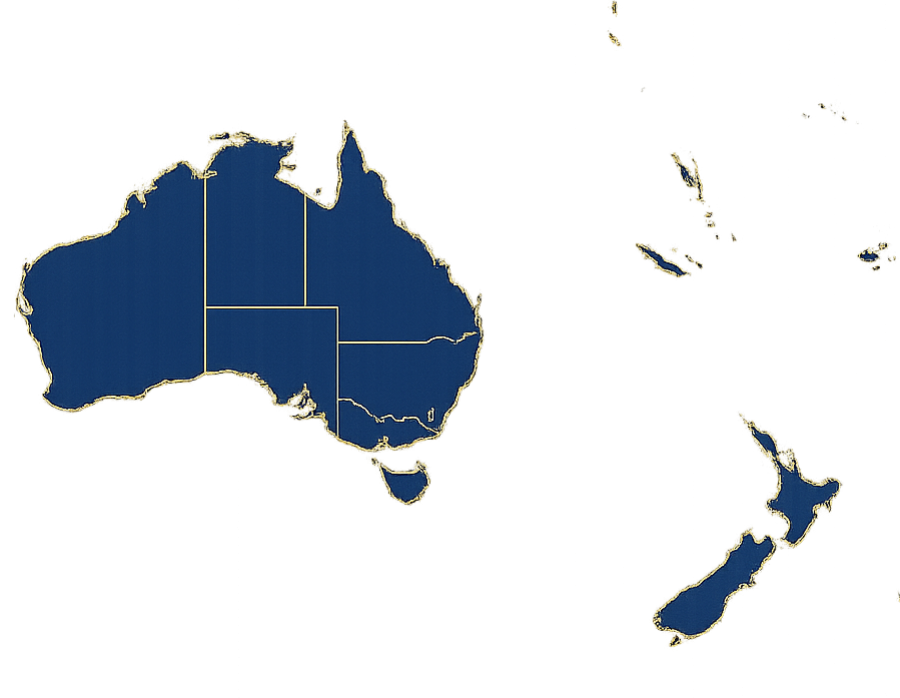
Massage Therapy Regulation & Requirements in Oceania,
Australia & New Zealand (Aotearoa & Pacific Island Nations)
UPDATED MARCH 2026
← Scroll across to view all details on smaller screens →
Massage Therapy Regulation & Requirements in Oceania Australia & New Zealand (Aotearoa & Pacific Island Nations)
Massage therapy across Oceania spans from sophisticated association-based professional standards in Australia and New Zealand, to island nations where massage is largely informal and rooted in community tradition. This overview summarizes practice frameworks s across the South Pacific to help with education planning, relocation research, and understanding the different ways “massage therapy” is categorized locally (clinical vs wellness vs traditional).
For country-by-country details, use the Global Regulation Lookup Tool.
Australia, New Zealand & Oceania at a glance
This region is defined by a divide between highly structured professional ecosystems (Australia/NZ) and many Pacific jurisdictions where massage is not established as a modern regulated profession and remains community-based or primarily hospitality-driven.
In Oceania, “regulated” often depends on setting (healthcare vs hospitality) and governance source (association/insurer vs ministry vs external governing nation).
Common regulatory patterns across the
Model 1 — Association-driven standards (Australia)
Australia does not use a national statutory registration system for massage therapists under AHPRA (Australian Health Practitioner Regulation Agency), but practice can still be tightly shaped by professional associations, codes of conduct, and insurer expectations, especially for remedial/clinical work and rebates.
Practical implication: a “license” may not be the main measure of practice competence; qualification level, association membership, and insurance eligibility often matter most.
Model 2 — Registration via professional scopes and competence assurance (New Zealand)
New Zealand uses a strong competence-registration culture through professional bodies and defined scopes of practice, with emphasis on competence assurance and cultural responsiveness (depending on the framework and service context).
Practical implication: scope-of-practice framing and documentation can be central to professional legitimacy.
Model 3 — Dual system: tourism spa regulation + culturally protected traditional healing (Pacific Islands)
Several countries are actively formalizing traditional medicine practice through policy frameworks and councils, sometimes including manual therapy categories alongside herbalism and bone-setting traditions.
Practical implication: governance may sit under traditional medicine councils, ministries, or hybrid systems rather than a standalone massage board.
Model 4 — Territories that follow regulation from external governing nations
U.S.-linked and French-linked territories frequently reflect the norms of their governing legal systems, including stricter constraints on clinical claims and who can practice within therapeutic and medical categories.
Practical implication: do not assume Oceania = one system. Territory status can change the rules dramatically.
Model 5 — Island nations with minimal modern professional regulation
For many independent island nations, there may be no modern statutory boards governing massage therapy as a distinct profession. Practice may be informal, community-based, or limited to small-scale wellness services.
Practical implication: verification often requires checking ministry/health department pages, tourism licensing rules (if applicable), and local norms.
What to verify in Australia, New Zealand & Oceania
If you’re training, moving, or offering services abroad, confirm:
- Practitioner vs facility regulation: Is oversight applied to the individual therapist, the establishment (spa/clinic), or both?
- Association/insurer requirements: In Australia and NZ, eligibility can depend on qualification level, association standards, and documentation for rebates/referrals.
- Scope boundaries: Are clinical or therapeutic claims restricted under physiotherapy or medical scope in some territories?
- Traditional healing vs commercial massage: Does the jurisdiction treat traditional healing modalities differently than commercial massage services?
- Territory inheritance of regulation: If it’s a U.S.- or French-linked territory, verify rules under the governing system.
- Documentation preparation: What proof or qualifications are needed? Certificates, CPD logs, association membership, insurance/rebate documentation?
Education and CE/CPD planning across the South Pacific
Across this region, continuing education expectations may be formalized through association CPD/CPE point systems (Australia/NZ contexts), or may be employer- and facility-driven in tourism-heavy jurisdictions. In smaller island nations where practice is not formally regulated, continuing education may be primarily a professional development choice vs. a legal requirement.
If renewal education is required (CE/CPD/CPE)
Confirm:
- annual/biennial CPD competency expectations
- what's accepted (formal courses vs professional activities)
- documentation requirements (certificates, logs, learning objectives)
If renewal education is not required
CE can still help build portability and credibility, especially if you plan to work in more regulated environments or within insurer/employer-driven systems.
How to use the Global Lookup Tool with this region page
This overview is designed to help you interpret the regulation status you’ll see in the global lookup tool.
- Use the Global Massage Lookup Tool to locate the country or territory you're looking into.
- Identify the regulation-status and look to see if rules are association-driven, facility-driven, governed nationally, or if rules are inherited via an outside governing nation.
- Verify the local scope + claims and boundaries of massage therapy with official sources before advertising therapeutic outcomes.
Pinpoint CE Training Courses
Pinpoint Education provides science-based continuing education for professional massage therapy designed with clear learning objectives and documentation. This is useful across diverse regulatory environments, including association and CPD systems, or contexts where employers and insurers expect training records. Acceptance varies by jurisdiction; verify what applies locally before enrolling.
Frequently Asked Questions (FAQ)
Why do requirements vary so much across Australia, New Zealand, and Pacific Island nations?
Because the Oceania includes both highly structured professional ecosystems (Australia/NZ) and many island nations where massage is not established as a modern regulated profession and remains community-based or hospitality-driven. Territories tied to external governing nations may follow stricter legal systems. Use the Global Lookup Tool to confirm which model applies in a specific country.
If Australia doesn’t have a national massage license, how are standards maintained?
In Australia, standards are often shaped through association requirements, codes of conduct, insurer expectations, and documentation norms, especially for clinical and remedial contexts.
How do traditional healing practices relate to commercial massage services in parts of Oceania?
In several Pacific contexts, traditional healing and bodywork can be culturally protected and governed through community lineage and practice norms, while commercial massage services operate under general business permits and facility standards.
Does “unregulated” mean it's illegal to practice massage?
Not necessarily. “Unregulated” usually means there is no dedicated professional licensing framework for massage as a distinct profession. Massage may still be permitted under general business and public health rules, and facility licensing can still apply in hospitality settings.